
Salary Benchmarking:
Can You Still Explain Your Pay Decisions?
8th June 2026 | Michelle Brown
Salary benchmarking helps organisations understand how competitive their pay is in the market. By comparing salaries against external market data, employers can assess recruitment and retention pressures, respond to changing workforce expectations and make more informed reward decisions.
However, market data only tells part of the story. While salary benchmarking can explain what competitors are paying, it cannot explain how pay decisions have evolved over time.
It also cannot explain whether similar roles are being treated consistently or whether an organisation’s overall pay structure remains coherent and defensible. As expectations around pay fairness and transparency continue to grow, these questions matter more than ever.
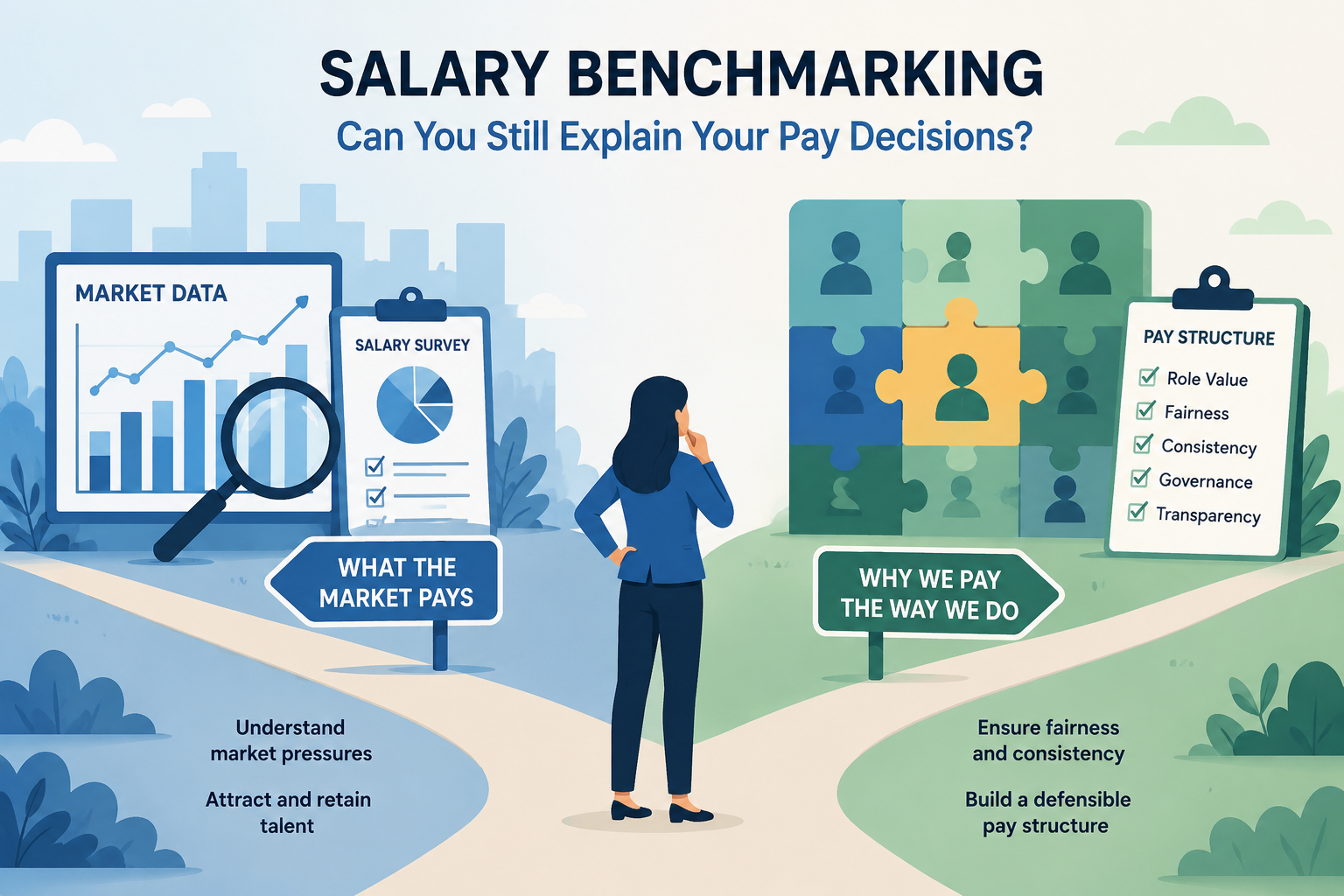
For many organisations, salary benchmarking is a key part of reward strategy and a logical response to recruitment and retention challenges. Labour markets move, skills become scarce and employers need to understand what competitors are paying if they are to attract and retain talent.
Salary surveys, benchmark reports and market data all provide valuable insight into external market conditions, helping organisations assess competitiveness and respond to changing workforce pressures. However, while benchmarking can tell an organisation what the market is paying, it cannot tell an organisation whether its own pay structure remains coherent, consistent and defensible.
That distinction is becoming increasingly important. Across both the public and private sectors, organisations are facing greater scrutiny of pay decisions than ever before.
Employees are asking more questions about pay fairness, trade unions are becoming increasingly active, and pay transparency initiatives are raising expectations around how organisations explain reward decisions.
As a result, senior leaders are finding themselves confronted by questions that go beyond market competitiveness. The challenge is no longer simply understanding what people are paid, but being able to explain why they are paid it.
Market value and organisational value are not the same thing
One of the most common assumptions in reward management is that market value and organisational value are broadly the same thing. They are related, but they are not interchangeable.
A role may command a premium in the labour market because certain skills are in short supply or particularly difficult to recruit. That may be entirely justified from a recruitment perspective.
However, external demand does not automatically determine how a role should be positioned relative to others within the organisation, nor does it explain how market-driven pay decisions affect the wider pay structure over time.
Understanding what the market values is important, but it is only one part of a much broader picture.

How pay structures evolve over time
This is where many organisations encounter difficulties. Pay structures rarely emerge from a single strategic decision. More often, they evolve gradually through hundreds of smaller decisions made over many years.
Recruitment challenges arise, retention concerns emerge, organisational structures change and responsibilities shift. Individual exceptions are approved for legitimate business reasons and market pressures create demands that require an immediate response.
Viewed in isolation, these decisions often make complete sense. Viewed collectively, however, they can create outcomes that nobody intended and that become increasingly difficult to explain when examined across the organisation as a whole.
The issue is not usually one poor decision. Rather, it is the cumulative effect of many reasonable decisions that were never considered together.
This is particularly common in organisations that have experienced growth, restructuring, mergers or prolonged recruitment challenges. Over time, different parts of the organisation can begin operating according to different assumptions about pay, grading and reward.
What began as sensible responses to individual circumstances can gradually alter the integrity of the wider pay structure, leaving organisations with arrangements that have evolved organically rather than through a clearly defined framework.
Salary benchmarking vs pay governance
At this point, the conversation shifts from market competitiveness to governance. Salary benchmarking and pay governance serve fundamentally different purposes.
Benchmarking helps organisations understand external market conditions and informs decisions about recruitment and retention. Governance, by contrast, focuses on understanding the impact of those decisions within the workforce itself.
It asks different questions. Are similar roles being treated consistently? Can pay differences be objectively explained? Have exceptions been reviewed appropriately? Does the overall structure still reflect the organisation’s intended approach to reward?
These questions are becoming increasingly significant because transparency is exposing decisions that were never designed to be scrutinised.
Historically, many organisations could rely on the fact that individual pay decisions were largely invisible. Recruitment premiums, retention payments, market adjustments and historic allowances often existed without significant challenge because few people had visibility of the wider picture.
Increasingly, that is no longer the case. Employees, regulators, trade unions and leadership teams are seeking greater clarity around how pay decisions are made and whether they remain justified over time.
The challenge organisations now face is not simply whether a decision was reasonable when it was made, but whether it can still be explained today.
Can the organisation evidence why a pay difference exists? Can it demonstrate that similar roles have been treated consistently? Can it show that exceptions have been governed appropriately and reviewed over time?
These are not purely reward questions. They are questions of leadership, accountability and organisational credibility.

Building a reward framework that can withstand scrutiny
This is one reason why many organisations are revisiting the foundations of their reward frameworks. Understanding market rates remains an essential component of reward strategy, but salary benchmarking data alone cannot provide a rationale for how roles relate to one another internally, nor can it provide assurance that decisions made over time remain coherent when viewed across the workforce as a whole.
Establishing internal role value, maintaining consistency and ensuring that exceptions are appropriately governed are all critical components of a reward framework that can withstand scrutiny and support pay transparency.
Can you still explain your pay decisions?
None of this diminishes the value of salary benchmarking. Used appropriately, it remains an important tool for understanding labour market conditions and informing workforce strategy.
The difficulty arises when organisations assume that market data alone is sufficient to justify pay decisions. Increasingly, stakeholders are asking different questions. Not simply, “What do we pay?” but “Why do we pay it?”
In that context, salary benchmarking can explain what the market is doing, but it cannot explain whether historic decisions remain justified, whether pay differences are consistent or whether the organisation’s overall pay structure remains coherent and defensible.
Perhaps that is the most important consideration of all.
If every employee in the organisation could see every salary tomorrow morning, which pay decisions would be hardest to explain?
For many organisations, the answer to that question reveals far more than any salary survey ever could.