
Achieve EU Pay Transparency Directive Compliance with Confidence
A proven, audit-ready job evaluation platform designed for fair, defensible pay decisions.

Why EU Pay Transparency Directive Compliance Requires More Than Policy
Most organisations already have pay policies in place.
The EU Pay Transparency Directive requires more. Organisations must be able to demonstrate, with evidence, that pay decisions are fair, consistent, and based on objective criteria.
With implementation approaching, organisations must move beyond policy into a practical, defensible application. This requires:
Objective job evaluation methods
Gauge+ applies a structured, analytical approach to job evaluation, ensuring every role is assessed using the same methodology, factors, and scoring principles, enabling fair, comparable outcomes.
Clear justification of pay decisions
Every evaluation in Gauge+ is supported by recorded rationale and structured outputs, creating a defensible link between role value and pay decisions that can withstand external scrutiny.
Robust reporting and documentation
Built-in reporting and a full audit trail allow organisations to respond confidently to queries, produce consistent outputs, and demonstrate compliance without relying on manual processes.
Ongoing governance - not one-off compliance
Gauge+ provides a centralised system to manage new roles, review changes, and maintain consistency over time, supporting long-term governance as requirements evolve.
How Gauge+ Supports EU Pay Transparency Compliance
Gauge+ supports organisations in moving from policy to practical application. It provides a structured, repeatable approach to job evaluation, embedding methodology, governance, and auditability directly into the process.
At the core of this is a guided, question-led evaluation. Each response determines the next step, narrowing the pathway and ensuring that only relevant criteria are considered. This removes subjectivity and creates a consistent, traceable foundation for decision-making.
The result is a controlled evaluation process that produces clear outputs and shows exactly how each decision was reached.
See how Gauge+ question logic supports EU Pay Transparency compliance →
Built on a Proven Analytical Framework
The Pilat Fixed Factor Job Evaluation Scheme
At the core of Gauge+ is the bespoke Pilat Fixed Factor (PFF) scheme, an analytical, factor-based methodology designed to enable consistent, objective evaluation of roles, and configurable for use in multiple languages.
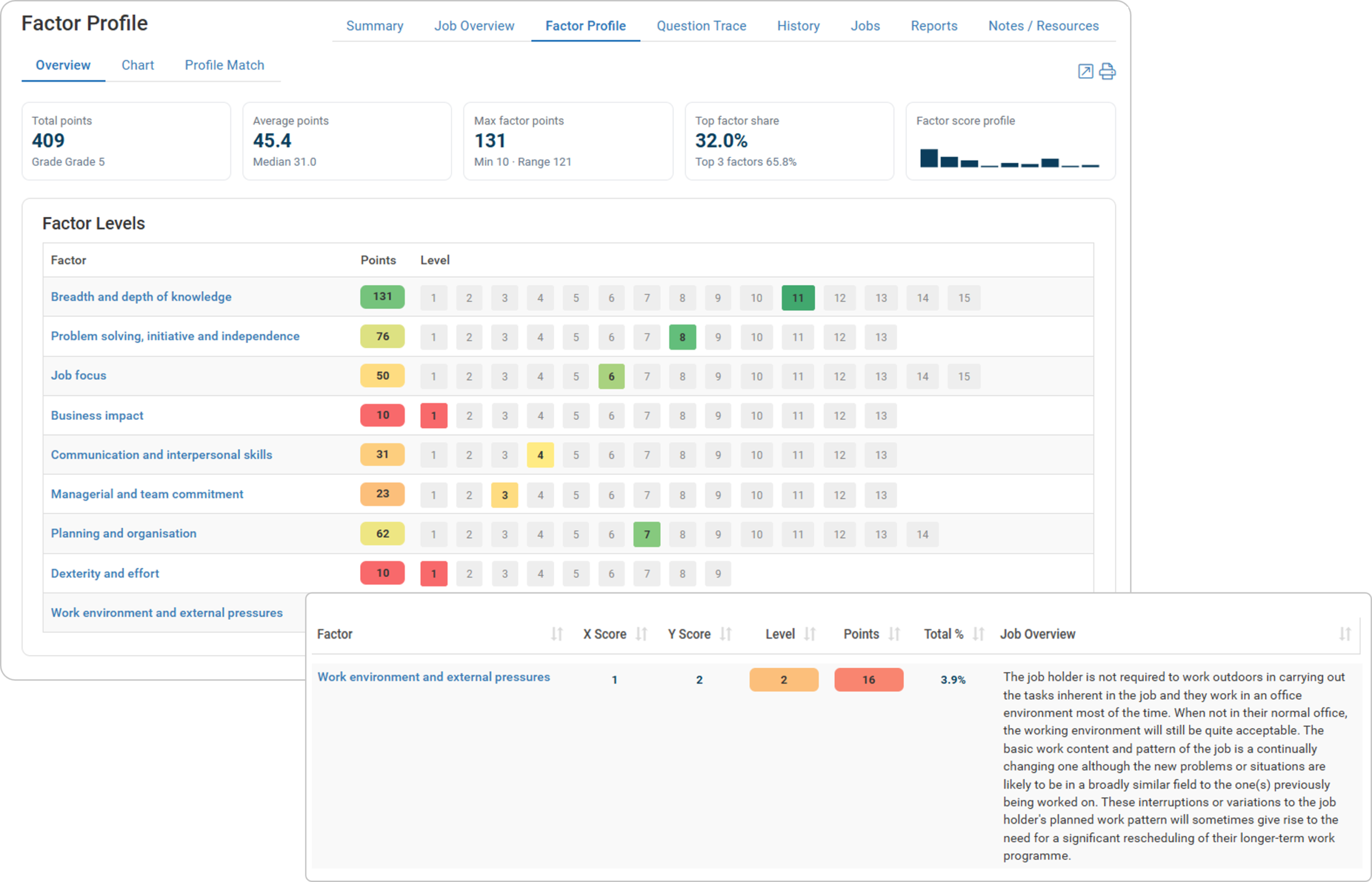
Roles are assessed against a defined set of factors that reflect the key demands of work, such as knowledge, problem-solving, and accountability.
Each factor is broken down into structured levels, with scoring applied consistently across all roles. This ensures that outcomes are based on the requirements of the role itself, not interpretation, influence, or inconsistency.
Consistent evaluation across all roles
Every role is assessed against the same fixed set of factors, using clearly defined levels and scoring principles to ensure comparable outcomes across departments, job families, and geographies.
Objective, gender-neutral assessment
The scheme focuses on the demands of the role, not the individual, using consistent scoring criteria to ensure evaluations are evidence-based, free from bias, and support fair, gender-neutral outcomes.
Clear comparison of roles of equal value
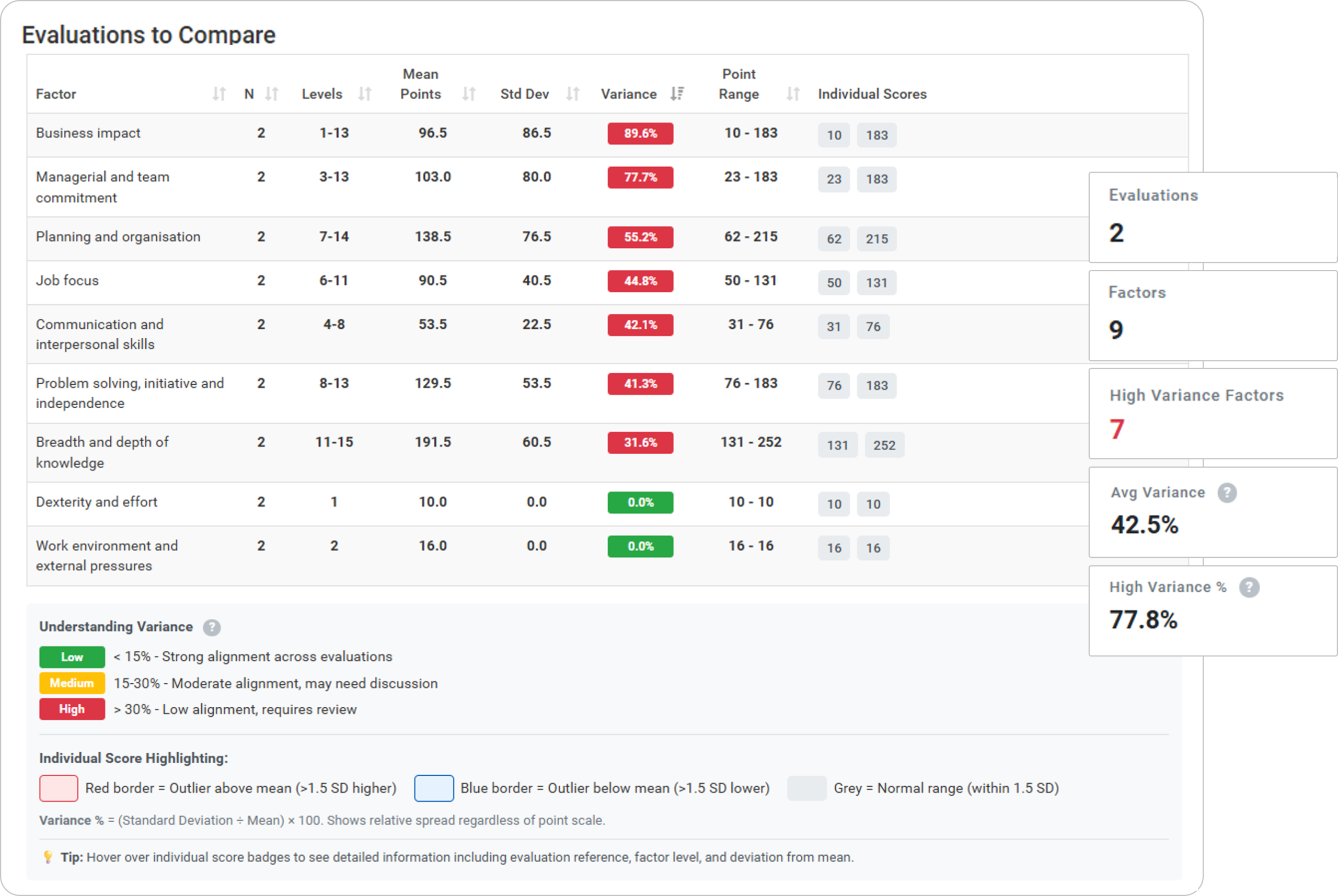
Analytical scoring across common factors enables direct comparison of roles, creating a transparent, evidence-based foundation for identifying work of equal value and addressing pay gaps.
Structured question logic for consistency
Gauge+ uses embedded question logic to guide evaluators through each factor, where each response determines the next step in the evaluation. Creating a Job Overview – playback of Q&A responses.
Designed for Transparency, Built for Scrutiny
Gauge+ provides the structure, visibility, and control needed to evidence every pay decision with confidence. Every evaluation is recorded, time-stamped, and fully traceable, allowing organisations to demonstrate clearly how and why decisions were made if challenged.
As a single source of truth for job evaluation data, it ensures consistency across roles, decisions, and reporting. It removes reliance on fragmented spreadsheets and supports ongoing governance, helping organisations maintain compliance over time, rather than as a one-off exercise.
Full Audit Trail
Every decision is recorded, time-stamped, and fully traceable, including evaluation scores, panel decisions, and the supporting rationale behind each outcome.
If challenged, you can demonstrate exactly how and why decisions were made.
Centralised Data & Reporting
A single source of truth for job evaluation data ensures consistency across roles and decisions. Structured data enables clear reporting for equal value comparisons and gender pay gap analysis.
No fragmented spreadsheets, just reliable, consistent data.
Spreadsheets and Informal Approaches Fall Short
Spreadsheets store data, but cannot enforce consistency or provide a defensible audit trail. Without structure, evaluations are inconsistent, decisions are harder to evidence, and comparisons lack credibility.
Gauge+ embeds structure, logic, and control into the evaluation process.
Scalable & Proven
Widely used across UK local government and established job evaluation schemes, Gauge+ is proven in complex, large-scale environments. It scales across teams, locations, and countries while maintaining consistency.
A solution that is trusted, tested, and already operating under scrutiny.
Frequently Asked Questions
What is required by organisations to do?
At its core, the Directive requires organisations to explain and justify pay decisions with evidence, not assumption.
This includes the need to:
- Be transparent about pay from the outset, including providing salary
ranges in job adverts - Report on gender pay gaps in a structured and consistent way
- Demonstrate that pay differences are based on objective, genderneutral criteria
- Take action where pay gaps cannot be explained
This is not just a reporting exercise. It represents a structural shift in how pay is defined, managed, and governed, with greater emphasis on consistency, transparency, and accountability.
Do organisations need a job evaluation scheme to comply?
Formal reporting requirements under the Directive relate primarily to gender pay gap reporting and are based on organisation size. These will be introduced in stages:
- Employers with 250 or more employees will report annually
- Employers with 150 to 249 employees will report every three years
- Employers with 100 to 149 employees will also report every three years, with obligations introduced later
While gender pay gap reporting is the main structured reporting requirement, organisations must also meet a range of ongoing obligations, including providing pay transparency in hiring, responding to employee requests for pay information, and being able to justify pay decisions.
The challenge is not just producing reports, but ensuring the underlying data and decisions can be clearly explained and defended.
What are “job categories” under the Directive?
This is one of the most misunderstood areas of the Directive.
The Directive requires reporting by “categories of workers doing the same work or work of equal value.”
These categories cannot be based on job titles alone and must be built on an objective comparison of roles.
This is where job evaluation becomes essential, providing the structure needed to define and group roles in a way that is consistent, evidence-based, and defensible.
A structured approach allows organisations to evaluate roles using consistent factors, identify comparable roles clearly, and create job categories that stand up to scrutiny.
When does it take effect?
EU member states are required to implement the Directive into national law by 7 June 2026.
From that point, key requirements, such as pay transparency and employees’ right to information, will begin to apply, although the exact timing may vary by country.
Some obligations, particularly gender pay gap reporting, will be introduced in phases, with the first reporting deadlines falling in 2027 and later depending on organisation size.
Given the scale of change required, most organisations will need to begin preparing well in advance.
What happens if we have an unexplained pay gap?
If a gender pay gap of 5% or more cannot be justified, organisations may be required to:
- Conduct a joint pay assessment
- Work with employee representatives or unions
- Identify the causes of the gap and implement corrective actions
This is a formal and resource-intensive process, and a clear area of risk.
Identifying issues early and ensuring role comparisons are evidence-based can help organisations address gaps before they reach this stage.
Be ready for the EU Pay Transparency Directive
Ensure your pay decisions are consistent, evidence-based, and ready to stand up to scrutiny.
See how to demonstrate equal pay for work of equal value
Understand how to defend pay decisions with confidence